

Briefly, what was the project’s aim?
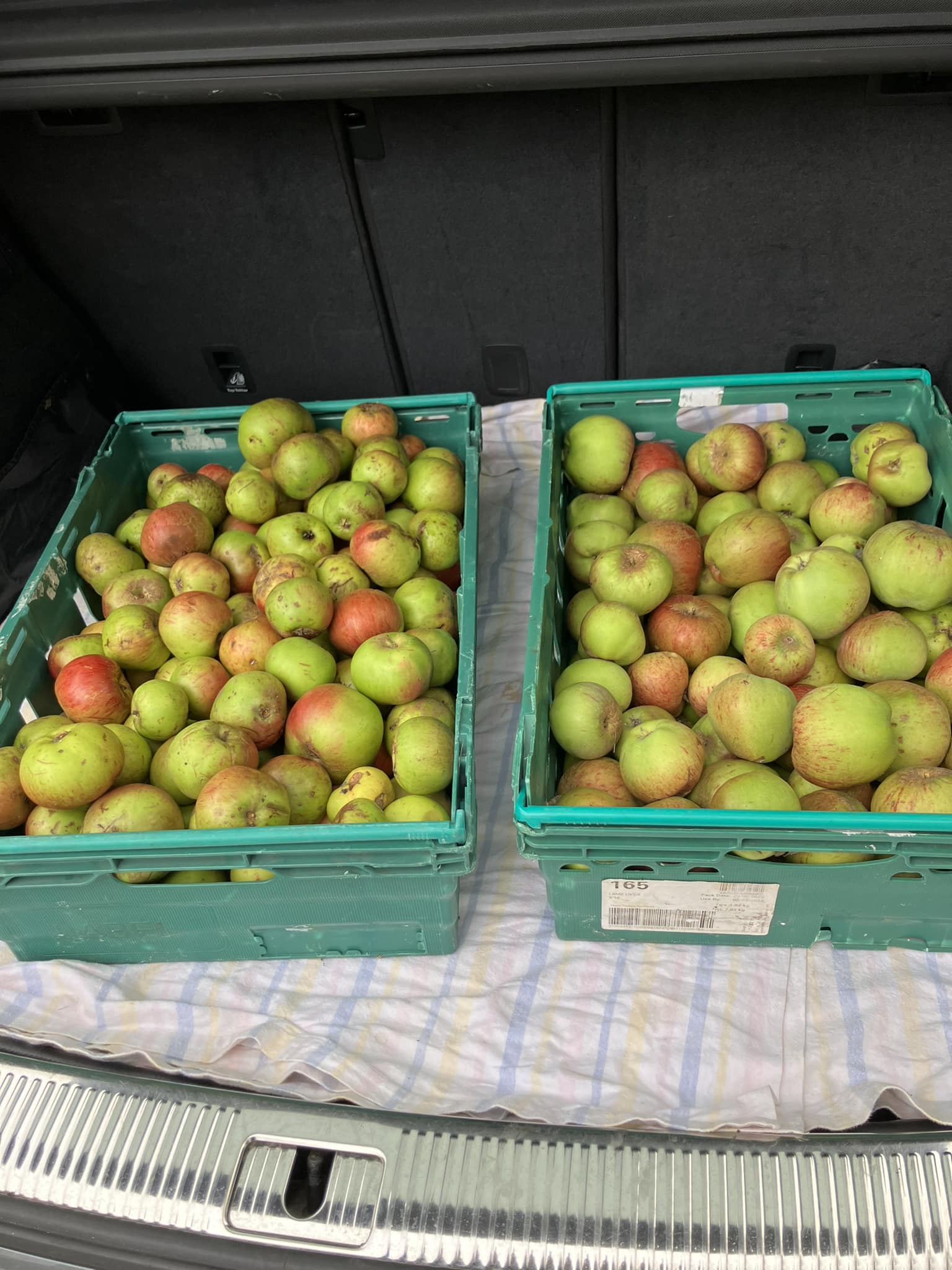
Ninewells Community Garden Apple Juice is produced from apples harvested from local gardens and NCG orchard. The juice is extracted using equipment purchased by the NCG with the aid of this grant from the Dundee Climate Fund. After extraction, the juice is packaged and pasteurised in 3 litre beverage pouches which are distributed to the apple donors and to the local community, thereby making good use of apples that would otherwise go to waste. Donations to support NCG funds are invited in return. Production started on a small scale in autumn 2024 with the production of 188 litres of apple juice produced from 360 kg of donated and locally harvested apples.
- Apple Harvest. All apples are carefully screened to exclude any fruit showing signs of rot, or significant bruising/damage likely to lead to rot during storage. Any apples that may have been exposed to contaminants are not used.
- Storage/washing. Apples are stored in shallow stackable, ex-grocery trays in cool, dry, rodent-free conditions in a large locked and sealed metal container shed. Washing is performed just before blending (see below) to avoid premature removal of their natural waxy coating which helps to protect them from decay during storage.
- Sorting. Before pressing, the apples are sorted into suitable mixtures of dessert/cooking apples to ensure a balance of sweetness and acidity in the juice. Transfer of apples from their storage trays to the blending trays provides a second opportunity for visual inspection to exclude any fruit that shows signs of rot or contamination.
- Milling and Pressing. On pressing day, a third and final visual inspection of the apples is made as they are transferred by hand (never poured) from their blending tray into the apple mill. As before, any fruit that shows signs of rot or contamination is discarded. Apple juice from the press is drained into a stainless-steel bucket through a 0.5 mm stainless steel mesh filter to remove any particles of apple pulp.
- Filling. The filtered juice is then transferred to a 3-litre measuring jug. Each measured volume of juice is poured (manually) through a perforated stainless steel filter funnel into a 3-litre beverage pouch (Smurfit Kappa Group plc), Vitamin C is added to a final concentration of 500 ppm, and the pouch is then sealed with its plug-in tap.
- Pasteurising. Sealed, filled pouches are pasteurised in batches of 3 (corresponding to 9 liters of juice per batch), by submerging for more than 10 minutes in a commercial pasteuriser containing 18 L of water preheated to 75oC.
- Tracking. Following pasteurisation each pouch will be labelled. The labels will be clearly labelled as ‘Ninewells Community Garden Apple Juice’. The date of packaging and pasteurising will be clear. Instructions will say ‘The apple juice can be stored at room temperature for up to 6 months. Once opened, refrigerate and consume within 14 days’. The label will clearly state the Best Before date and a batch number.
- Ninewells Community Garden (NCG) acknowledges with grateful thanks the help and support from volunteer colleagues in Tayport Community Garden who assisted with advice on equipment specification, purchasing, setting up and training for NCG apple producing team. Also for sharing detailed protocols on Hazard Analysis and Critical Control and detailed Point Plan for producing Pasteurised Apple Juice. This has underpinned confidence to safely and effectively develop the project quickly from a standing start at award of the grant in June 2024 to active production over the apple harvesting season in 2024.
 Ninewells Community Garden