


Volunteer Siobhan attended the July 2021 Moth Workshop and has shared her experience here
On Friday 9th July at 10am I attended a moth activity session at the Ninewells Community garden to celebrate national moth night.
The Event was hosted by David Lampard, Curator of Geology & zoology based at McManus Galleries.
David, along with Jim D, (our trustee whom organised the event) arrived at the garden at 9.30pm the previous night to set up the trap ready for it getting dark at about 11pm.
The trap was set up in woodland clearing in front of the garden in the arboretum surrounded by a variety of habitats including uncut grass, patches of nettles, willow herb and trees.
As it started to get dark, David did a bit of dusking, searching the undergrowth with a head torch and net to attract emerging moths. The plan was for David and Jim to catch the moths before they got inside the trap and identify them by torchlight. They would carry on doing this until the numbers decreased at 3am!
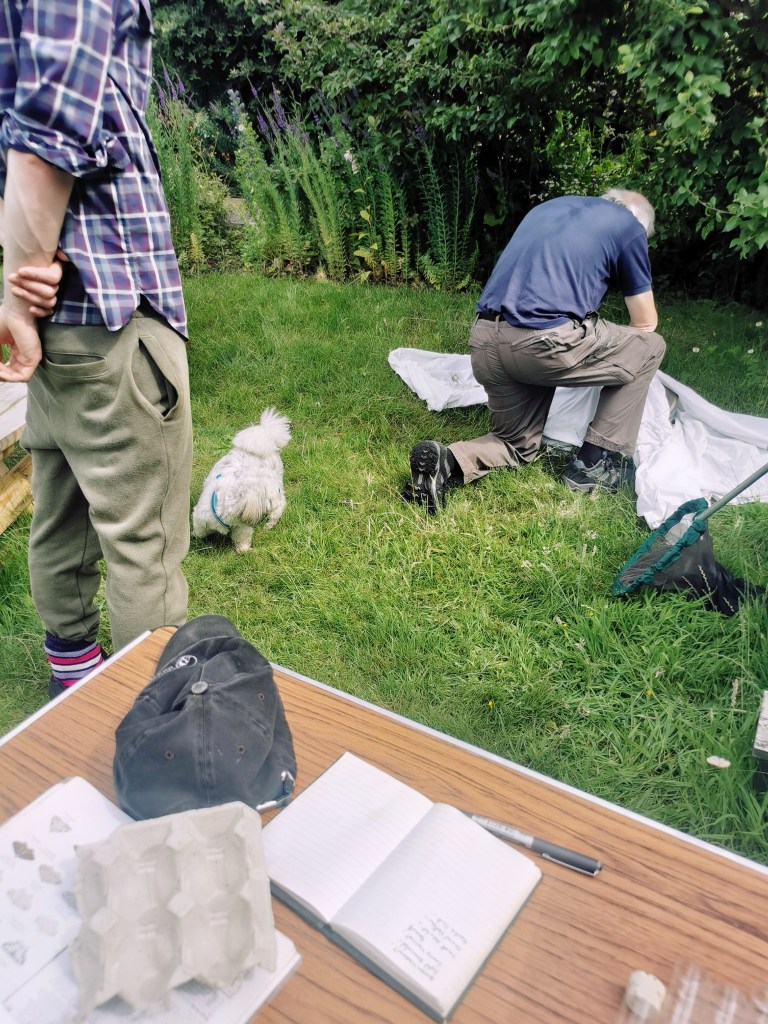
The trap was wrapped up and left until 10am the next day for the 2nd part of the Activity which I attended along with 5 other participants.
We were given insect nets as the trap was unwrapped to catch and transport the moths to a test tube to be identified and counted. David and Jim provided Moth guide books to help us identify them and showed us the most important features to concentrate on.

The Kidney mark is a mark near to the outer edge of the wing which is really important in identifying nocturnal moths. For example ‘the Heart and dart’ which has a heart shape at the kidney and a straight line above which looks like a dart.
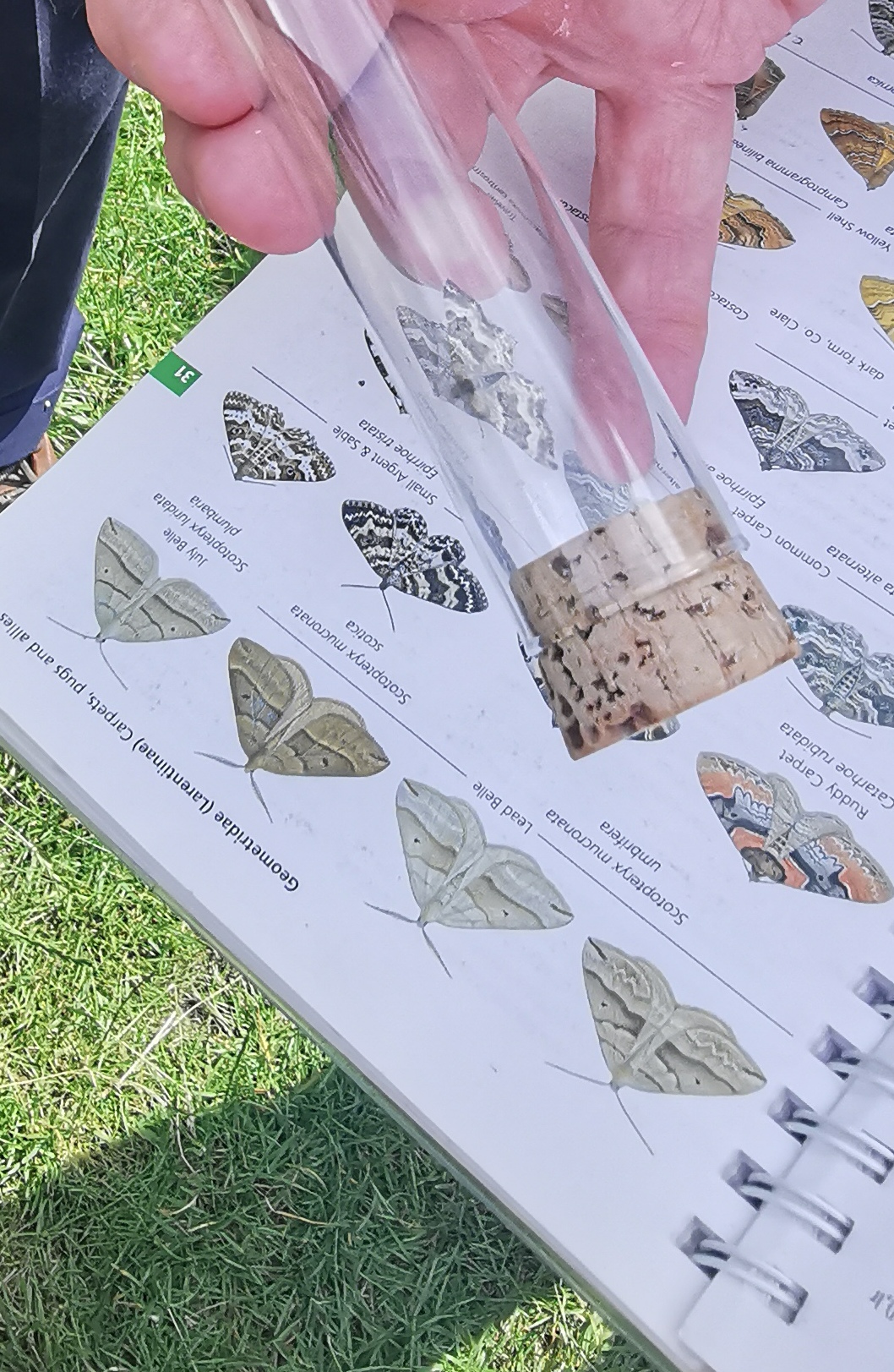
In this photo David has studied the moth and is trying to tell if this is the Common Carpet moth, the Silver ground carpet moth or the Garden carpet moth which are all very similar. One of the most common problems which come up when trying to identify the different moths is how similar they can look even under the microscope.

moth in a Specimin jar 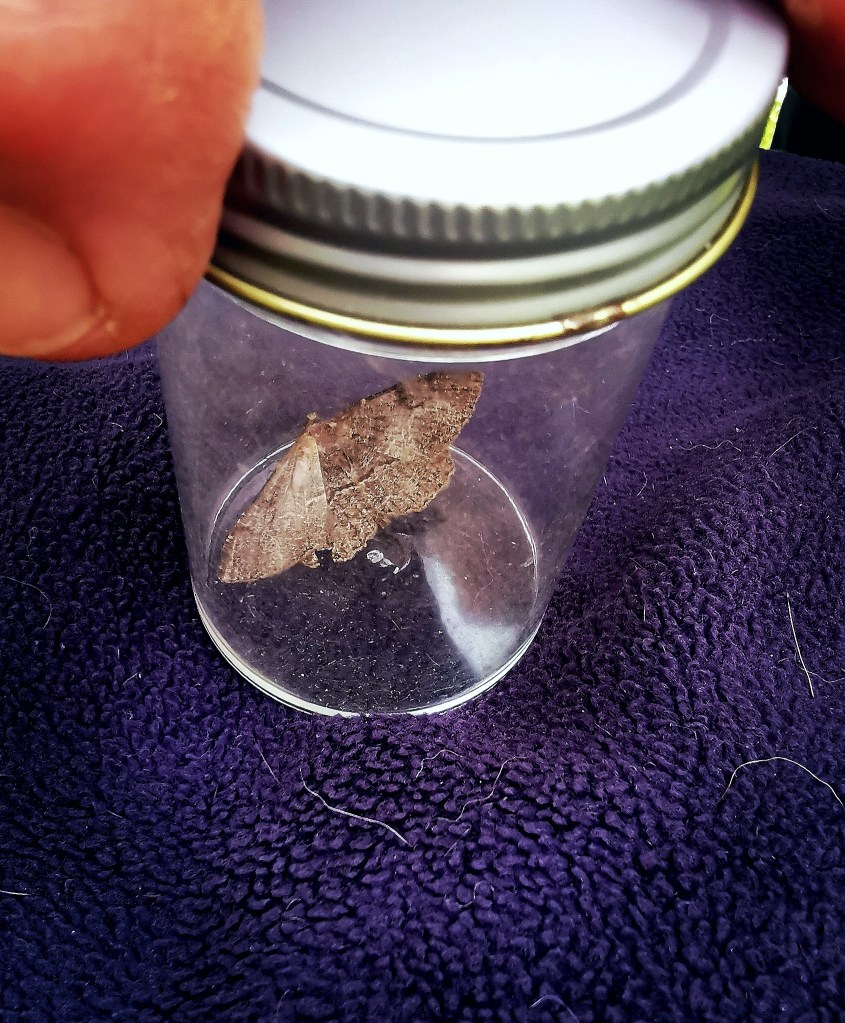
Mottled Beauty
In this one Jim is showing me what David initially thought was the Willow Beauty moth, but it turned out to be the mottled beauty which again are very similar.
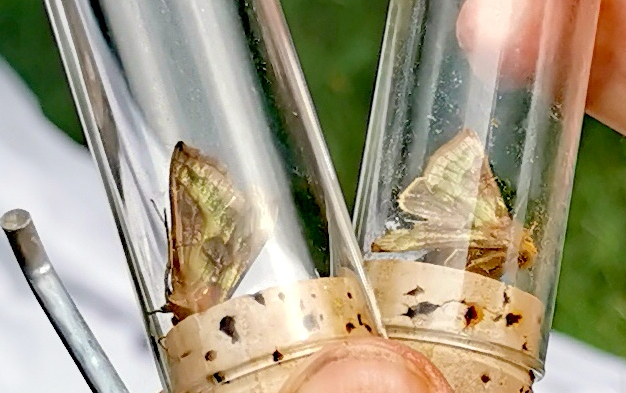
Here are the aptly named ‘Burnished brass’ moths which have a bright luminous quality and could be mistaken for butterflies.
It took over 2 hours to empty the trap and identify most of the moths and another hour to identify the trickier ones.
The final list of all the moths ended up as a total of 33 species not counting micro moths (listed below).
134 moths were counted not including micros and escapees.
Everyone who attended the Activity thoroughly enjoyed it and the Ninewells Community Garden is keen to host another one soon so watch this space!
| Scientific name | Common name | Number | |
| Pandemis cerasana | Barred Fruit-tree Tortrix | 3 | |
| Tortrix viridana | Green Oak Tortrix | 5 | |
| Idaea aversata | Riband Wave | 2 | |
| Xanthorhoe fluctuata | Garden Carpet | 1 | |
| Xanthorhoe montanata | Silver-ground Carpet | 1 | |
| Epirrhoe alternata | Common Carpet | 1 | |
| Cidaria fulvata | Barred Yellow | 2 | |
| Perizoma alchemillata | Small Rivulet | 2 | |
| Opisthograptis luteolata | Brimstone Moth | 2 | |
| Ourapteryx sambucaria | Swallow-tailed Moth | 1 | |
| Alcis repandata | Mottled Beauty | 3 | |
| Cabera pusaria | Common White Wave | 1 | |
| Campaea margaritaria | Light Emerald | 2 | |
| Rivula sericealis | Straw Dot | 1 | |
| Hypena proboscidalis | Snout | 12+ | |
| Herminia tarsipennalis | Fan-foot | 1 | |
| Abrostola tripartita | Spectacle | 1 | |
| Diachrysia chrysitis | Burnished Brass | 7 | |
| Hoplodrina octogenaria | Uncertain | 5 | |
| Euplexia lucipara | Small Angle Shades | 1 | |
| Apamea sordens | Rustic Shoulder-knot | 1 | |
| Apamea monoglypha | Dark Arches | 3 | |
| Oligia strigilis | Marbled Minor | 3 | |
| Oligia fasciuncula | Middle-barred Minor | 17 | |
| Cerapteryx graminis | Antler Moth | 2 | |
| Anarta trifolii | Nutmeg | 1 | |
| Mythimna impura | Smoky Wainscot | 10 | |
| Agrotis exclamationis | Heart & Dart | 6 | |
| Axylia putris | Flame | 1 | |
| Ochropleura plecta | Flame Shoulder | 2 | |
| Noctua pronuba | Large Yellow Underwing | 5 | |
| Xestia baja | Dotted Clay | 4 | |
| Xestia triangulum | Double Square-spot | 25 |
Photos and Text by Siobhan Croll except Heart and Dart moth- photo by Helena Simmons, List of Moths identified supplied by David Lampard
 Ninewells Community Garden